

लघुगणक

स्कॉटलैंड निवासी जाॅन नेपियर द्वारा प्रतिपादित लघुगणक (Logarithm / लॉगेरिद्म) एक ऐसी गणितीय युक्ति है जिसके प्रयोग से गणनाओं को लघु या छोटा किया जा सकता है। इसके प्रयोग से गुणा और भाग जैसी जटिल प्रक्रियाओं को क्रमशः जोड़ और घटाने जैसी अपेक्षाकृत सरल प्रक्रियाओं में बदल दिया जाता है। संगणक (computer) और परिकलक (calculator) के आने के पहले जटिल गणितीय गणनाएँ लघुगणक की मदद से ही की जातीं थीं।
परिभाषा[संपादित करें]
गणित में किसी दिए हुए आधार पर किसी संख्या का लघुगणक वह संख्या होती है जिसको उस आधार के ऊपर घात लगाने से उसका मान दी हुई संख्या के बराबर हो जाय। उदाहरण के लिये, १० आधार पर १००००० (एक लाख) का लघुगणक ५ होगा क्योंकि आधार १० पर ५ घात लगाने से उसका मान १००००० हो जाता है।
अर्थात किसी संख्या x, आधार b और घातांक n, के लिये

यह परिभाषा तभी वैध है जब आधार b, 1 के अलावा कोई अन्य धनात्मक वास्तविक संख्या हो, अर्थात् b> 0 y b ≠ 1, x कोई भी धनात्मक वास्तविक संख्या हो (x > 0) तथा n कोई भी वास्तविक संख्या हो (n ∈ R)।
प्रत्येक लघुगणक का आधार होना आवश्यक है। भिन्न भिन्न आधारों के लिए एक ही संख्या के भिन्न भिन्न लघुगणक होते हैं। साधारणत: आधार के लिए दो संख्याओं का व्यवहार होता है, जिनके अनुसार लघुगणक की दो प्रणालियाँ बनाई गई हैं।
प्राकृतिक प्रणाली में लघुगणक का आधार एक अपरिमेय संख्या e मानी जाती है। इसके आविष्कारक जॉन नेपियर के नाम पर ऐसे लघुगणकों को 'नेपिरीय लघुगणक' भी कहते हैं। e का मान एक अनन्त श्रेणी द्वारा व्यक्त होता है और लगभग 2.7182818...... के बराबर है। उच्च गणित के सैद्धांतिक कार्यों के लिए इसी प्रणाली का उपयोग होता है।
दूसरी प्रणाली के आविष्कारक हेनरी ब्रिग हैं। इस प्रणाली में लघुगणक का आधार 10 है। इसे 'साधारण लघुगणक' (common logarithm) कहते हैं। यह व्यावहारिक प्रयोगों के लिए उपयुक्त है।
प्रतिलघुगणक : यदि log a = b तो b को a का प्रतिलघु (एण्टीलॉग) कहते हैं। जैसे, log 39.2 = 1.5933, तो antilog 1.5933 = 39.2
लघुगणकों के गुण[संपादित करें]
जब x और b दोनो धनात्मक वास्तविक संख्याएँ हों तो, logb(x) का मान एक अद्वितीय वास्तविक संख्या होती है। आधार b का निरपेक्ष मान 0 या 1 को छोड़कर कुछ भी हो सकता है। आधार के रूप में प्रायः 10, e या 2 को लिया जाता है जिनके अपने-अपने उपयोग-क्षेत्र हैं। वास्तविक संख्याओं तथा समिश्र संख्याओं के लघुगणक पारिभाषित हैं।
निम्नलिखित परिणाम लघुगणक की परिभाषा से सीधे ही आ जाते हैं-
- ,

- ,

- .

- ,

अतः
- ,

तथा
- ,

- ,
![{\displaystyle \log _{a}{\sqrt[{n}]{b^{c}}}={\tfrac {c}{n}}\log _{a}b}](https://wikimedia.org/api/rest_v1/media/math/render/svg/71314bdca0c12b9c1bf0cbb99c72b2f4c3fa15b8)
अन्ततः
- ,

- ,
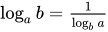
इसलिये
- ,

जिसकी एक विशेष स्थिति निम्नलिखित है-
- .

उपरोक्त से निम्नलिखित सर्वसमिका (equality) प्राप्त होती है-
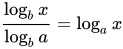
अथवा:

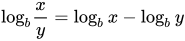
- सारांश और उदाहरण
| सूत्र | उदाहरण | |
|---|---|---|
| गुणनफल | ||
| भागफल | ||
| घात (पॉवर) | ||
| मूल |





![{\displaystyle \log _{b}{\sqrt[{p}]{x}}={\frac {\log _{b}x}{p}}}](https://wikimedia.org/api/rest_v1/media/math/render/svg/85de3061851d6fb9347dc78ffcaed1775391138e)

पूर्णांश (Characteristic) और अपूर्णांश (Mantissa)[संपादित करें]
किसी संख्या के लघुगणक के पूर्णांक भाग को पूर्णाश और दशमलव भाग को अपूर्णांश कहते हैं। उदाहरण के लिये log10(4576) = 3.66048 होता है। 3.66048 में 3 पूर्णांश और 0.66048 अपूर्णांश है।
किसी संख्या के लघुगणक का पूर्णांश ज्ञात करने का नियम निम्नलिखित है :
- (1) जिस धनात्मक संख्या (>1) के पूर्णांक भाग में M+1 अंक हो, उस संख्या के लघुगणक का पूर्णांश M होता है। जैसे 245 के लघुगणक का पूर्णांश 2 होगा क्योंकि 245 में (2+1) अंक हैं। इसी प्रकार 245.67 का पूर्णांश भी 2 ही होगा क्योंकि 245.67 के पूर्ण भाग में (2+1) अंक ही हैं।
- (2) जिस धनात्मक संख्या (<1) में दशमलव बिंदु के बाद M शून्य के बाद कोई अशून्य अंक आता हो, उसके लघुगणक का पूर्णांश -(M+1) होता है। जैसे 0.0034 में दशमलव के बाद दो शून्य आने के बाद ही अशून्य अंक (3) आ रहा है; इसलिये इसका पूर्णांश = -(2+1) = -3 (ऋण तीन) होगा।
अपूर्णांश ज्ञात करने का नियम निम्नलिखित हैं :
अपूर्णांश संख्या के मान और उसमें व्यवहृत अंकों के क्रम पर निर्भर करता है। यदि दो संख्याओं में एक ही प्रकार के अंक एक ही क्रम में व्यवहृत हों और केवल दशमलव बिंदु का स्थान भिन्न हो, तो उन संख्याओं के अपूर्णांश एक ही होंगे, क्योंकि अपूर्णांश संख्या में दशमलव बिंदु के स्थान पर निर्भर नहीं होता है। उदाहरण के लिये 4538 और 45.38 दोनो के अपूर्णांश समान होंगे यद्यपि दोनो के पूर्णांश अलग-अलग (क्रमशः 3 तथा 1) होंगे।
इतिहास[संपादित करें]

स्कॉटलैंड निवासी जॉन नेपियर तथा स्विट्जरलैंड के जूस्ट बुर्गी (Joost Burgi) ने स्वतंत्र रूप से लघुगणक का आविष्कार किया। इन दोनों के लघुगणक एक दूसरे से भिन्न थे तथा प्राकृतिक लघुगणक और सामान्य लघुगणक भी भिन्न थे। नेपियर का लघुगणक 1614 ई. में एड्नवर (Edinburgh) में मिरिफिसी लॉगेरिथमोरम केनोनिस डिसक्रिप्शियो (Mirifici logarithmorum canonis descriptio) शीर्षक के अंतर्गत प्रकाशित हुआ। 1620 ई. में प्रेग (Prague) में जूस्ट बुर्गी का लघुगणक अरिथमेटिशे उंडर ज्योमेट्रिशे प्रोग्रेस टेबूलेन (Arithmetische under Geometrische Progress Tabulen) शीर्षक के अंतर्गत प्रकाशित हुआ। इस समय तक सारे यूरोप में नेपियर के लघुगणक का प्रचार हो चुका था। उनके सिद्धांत एवं परिकलन पद्धति का पूर्ण उल्लेख, उनकी पुस्तक मिरिफ़िसी लॉगरिथमोरम केनोनिस कंस्ट्रक्सियो, (Mirifice logarithmorum canonis constructio) में मिलता है, जो उनकी मृत्यु के दो वर्ष पश्चात् 1619 ई. में प्रकाशित हुई। डब्लू.आर. मैक्डॉनैल्ड (W.R. Macdonald) ने इसका अंग्रेजी में अनुवाद 1889 ई. में किया। 1614 ई. के नेपिरियन लघुगणक तथा प्राकृतिक लघुगणक का पारस्परिक संबंध निम्न ढंग से व्यक्त किया जाता है :
- नेप लघु र = 107 लघु (10 / र)
नेपियर ने इकाई के लघुगणक का मान शून्य नहीं माना था। फलस्वरूप इनके सिद्धांत के अनुसार, बिना संशोधन के लधुगणक से संगत समीकरण बल = न संभव नहीं था।
1620 ई. के बुर्गी (Burgi) के प्रकाशन में प्रतिलघुगणक (anti-logarithm) की सारणी है। इसमें लघुगणक लाल और संख्याएँ काले रंग में छपी हैं। इनका ग्रुंडलिखे उटररिख्ट (grundliche unterricht) 1856 ई. में प्रकाशित हुआ, जिसमें इकाई के लघुगणक को शून्य माना गया है। बुर्गी की सारणी की कुछ पंक्तियाँ उदाहरणार्थ नीचे दी गई है :
लाल--- 0--- 10--- 20--- ........
काली--- 100000000--- 100010000--- 100020001--- ........
पहली पंक्ति समांतर श्रेणी है। दूसरी पंक्ति गुणोत्तर श्रेणी है, जिसका सामान्य अनुपात (common ratio) 1.0001 है। दूसरी पंक्ति के अंत के आठ अंक दशमलव अंक माने गए हैं और काले रंग में व्यक्त किए गए हैं। यदि 1.0001 का लघुगणक 10 है, तो स्पष्ट है कि इसका आधार = 1.00000999 ....... है। लघुगणक के आधार के संबंध में बुर्गी का ज्ञान नेपियर से अधिक प्रतीत नहीं होता।
जॉन वॉलिस (John Wallis) ने 1685 ई. तथा बेर्नूली ने 1694 ई. में लघुगणक से संगत समीकरण बल = न का अनुमान किया। इस विचार पर आधारित लघुगणक का उल्लेख 1742 ई. से मिलता है। इसका वर्णन गार्डिनर्स टेबुल्स ऑव लॉगैरिथम्स (Gardiners Tables of Logarithms) की भूमिका में मिलता है। इसका श्रेय विलियम जोम्स (William Jones) को दिया जाता है।
प्राचीन भारत में मूलभूत लघुगणक का उपयोग 'षट्खण्डागम' (150 ई) में देखने को मिलता है। षट्खण्डागम की धवला टीका में अर्धच्छेद, त्रयच्छेद, चतुर्छेद आदि शब्दों का प्रयोग किया गया है जो बिलकुल लघुगणक की क्रिया जैसा ही है। उदाहरण के लिये ३२ का अर्धच्छेद ५ है जो बताता है कि ३२ को बार-बार आधा करें तो ५-बार में १ आ जाता है। इसी तरह ८१ का त्रयच्छेद ४ है क्योंकि ८१ को बार-बार तिहाई करें तो ४-बार में १ आ जाता है। ध्यान देने योग्य है कि ये क्रियायें क्रमशः log2, log3 आदि जैसी ही हैं।
साधारण लघुगणक (Common logarithm)[संपादित करें]
साधारण लघुगणक का विकास जॉन नेपियर और हेनरी ब्रिग के सम्मिलित प्रयास का फल है। इसका उल्लेख ब्रिग के 'ऐरिथमेटिका लॉगरिथमिका' (Arithmetica Logarithmica) में है।
यदि र वृत्त की त्रिज्या है, तो ब्रिग का सुझाव था कि लघु र = 0 और लघु = 1010। नेपियर के अनुसार लघु 1 = 0, लघु र = 1010। कुछ समय के पश्चात् लघु र = 1010 के स्थान पर लघु 10 = 1 का व्यवहार होना आरंभ हुआ। ब्रिग के 1624 ई. के प्रकाशन में 1 से 20,000 और 90,000 से 1,00,000 के लघुगणक का दशमलव के 14 स्थान तक का उल्लेख है। 20,000 से 90,000 के लघुगणक ऐड्रिऐन ब्लाक (Adrian Vlacq) द्वारा निकाले गए। ब्रिग की 1624 ई. की सारणी में कैरेक्टेरिस्टिक (characteristic) शब्द का उल्लेख है। 1693 ई. में जॉन वॉलिस ने अपनी बीजगणित की पुस्तक में मैंटिसा (mantissa) शब्द का प्रयोग किया है।
प्राकृतिक लघुगणक (Natural logarithm)[संपादित करें]
सर्वप्रथम प्राकृतिक लघुगणक का उल्लेख नेपियर्स डिस्क्रिप्शियो (Napier's Descriptio) में मिलता है, जो एडवर्ड राइट (Edward Wright) द्वारा अनुवादित 1618 ई. के अंग्रेजी संस्करण में जॉन स्पेडील्स न्यू लॉगैरिथम्स (John Speidells New Logarithms) के 1622 ई. के संस्करण में 1 से 1000 तक की लघुगणक सारणी है। ये सब प्राकृतिक लघुगणक है, केवल दशमलव बिंदु लुप्त है। जुसात्ज़े ज़ू डेन लॉगरिथेमिशेन अंड ट्रिगोनोमेट्रिशेन टेबिलेन (Zusatza zu den Logarithmischen and Trigonometrischen Tabellen) में 1770 ई. में जोहैन हाइनरिख लैबर्ट (Johann Heinrich Lambert) ने दशमलव के सात स्थान तक 1-100 के प्राकृतिक लघुगणक प्रकाशित किए। दशमलव के 48 स्थान तक, 1778 ई. में वालफ्राम (Walfram) ने 1-10000 के लघुगणक जे.सी. शुल्ट्सेज़ सामलुंग (J.C. Schulze's Sammlung) में प्रकाशित किए।
गाउसीय लघुगणक (Gaussian Logarithms)[संपादित करें]
यदि लघु10 अ+लघु10 ब का मान ज्ञात हो, तो बिना अ और ब का मान ज्ञात किए बहुधा लघु10 (अ ± ब) का मान ज्ञात करने की आवश्यकता पड़ती है। इस उद्देश्य से 1803 ई में ज़िखीनी ल्योनेली (Zecchini Leonelli) ने एक नए प्रकार की लघुगणक सारणी निकाली। इसी प्रकार की, दशमलव के 5 स्थान तक यथार्थ, लघुगुणक सारणी गाउस (Gauss) ने 1812 ई. में प्रकाशित की। इसे गाउसीय लघुगणक कहते हैं।
लघुगणक सारणी के परिकलन की विधियाँ[संपादित करें]
जॉन नेपियर, हेनरी ब्रिग, जेम्य ग्रेगोरी, ऐब्राहम शार्प तथा अन्य गणितज्ञों ने भिन्न-भिन्न पद्धतियों का उपयोग लघुगणक सारणी के निर्माण में किया है। निकोलस मर्केटर (Nicolas Mercator) ने 1668 ई. में लघु (1+य) की अनन्त श्रेणी प्राप्त की :
- लघु (1+x) = x - (x2 / 2) + (x3 / 3) . . . (-1 < x < 1)
किन्तु संगणन में यह अधिक लाभप्रद नहीं है। 1695 ई. में जॉन वालिस ने निम्नलिखित अनन्त श्रेणी का प्रयोग किया :
- (1/2) Log ((1+x) / (1-x)) = x + x3 / 3 + x5 / 5 + ...
इस श्रेणी की अभिसृति (कन्वर्जेन्स) शीघ्रतर है। 1794 ई. में जी.एफ. भेगा द्वारा लिखित थिसॉरस (Thesaurus) में x = (2y2-1)−1 मानकर श्रेणी की अभिसृति अधिक शीघ्रतर कर दी गई है।
साधारणत: सारणी के उपयोग में अनुपाती अंशसिद्धांत की सहायता ली जाती है।
लघुगणकीय प्रवर्धक[संपादित करें]

सामने के चित्र में ऑप-ऐम्प का आउटपुट, इनपुट संकेत के लघुगणक के समानुपाती होता है। ऐसे प्रवर्धक का उपयोग वहाँ किया जाता है जहाँ इनपुट संकेत में परिवर्तन बहुत अधिक (कई परिमाण की कोटि) होता हो किन्तु आउटपुट में सीमित परिवर्तन चाहते हों। इससे संकेत का गतीय परास (डाइनेमिच रेंज) सिकोड़ दी जाती है।
लघुगणकों के उपयोग[संपादित करें]
लघुगणक का प्रयोग ऐसे समीकरणों को हल करने के लिये किया जाता है जिनमें अज्ञात राशि घात के रूप में हो। चूँकि लघुगणकीय फलन का अवकलज बहुत सरल फलन होता है, इसलिये इनका उपयोग इन्टीग्रल निकालने में होता है। लघुगणक, घातांक (exponentials) तथा करणी (radicals) - ये तीनों आपस में बहुत घनिष्टता से जुड़े हुए हैं। समीकरण bn = x, में b का मान करणी द्वारा निकाला जा सकता है; n का मान लघुगणक द्वारा निकाला जा सकता है तथा x का मान घात द्वारा।
विज्ञान[संपादित करें]
विज्ञान में बहुत सी राशियाँ दूसरी राशियों के लघुगणक के रूप में व्यक्त की जातीं हैं। इसकी अधिक विस्तृत सूची के लिये लघुगणकीय पैमाना देखें।
- रसायन विज्ञान में हाइड्रोजन ऑयन के सान्द्रण के व्युत्क्रम के साधारण लघुगणक (H3O+, the form H+ takes in water) को पीएच (pH) कहा जाता है। 25 °C पर शुद्ध जल में हाइड्रोजन आयनों का सांद्रण 10−7 मोल/लीटर होता है; अतः शुद्ध जल का pH = 7.
 | यह सम्पूर्ण पृष्ठ या इसके कुछ अनुभाग हिन्दी के अतिरिक्त अन्य भाषा(ओं) में भी लिखे गए हैं। आप इनका करके विकिपीडिया की सहायता कर सकते हैं। |
- The bel (symbol B) is a unit of measure which is the base-10 logarithm of ratios, such as power levels and voltage levels. It is mostly used in telecommunication, electronics, and acoustics. The Bel is named after telecommunications pioneer Alexander Graham Bell. The decibel (dB), equal to 0.1 bel, is more commonly used. The neper is a similar unit which uses the natural logarithm of a ratio.
- The Richter scale measures earthquake intensity on a base-10 logarithmic scale.
- In spectrometry and optics, the absorbance unit used to measure optical density is equivalent to −1 B.
- In astronomy, the apparent magnitude measures the brightness of stars logarithmically, since the eye also responds logarithmically to brightness.
- In psychophysics, the Weber–Fechner law proposes a logarithmic relationship between stimulus and sensation.
- In computer science, logarithms often appear in bounds for computational complexity. For example, to sort N items using comparison can require time proportional to the product N × log N. Similarly, base-2 logarithms are used to express the amount of storage space or memory required for a binary representation of a number—with k bits (each a 0 or a 1) one can represent 2k distinct values, so any natural number N can be represented in no more than (log2 N) + 1 bits.
- Similarly, in information theory logarithms are used as a measure of quantity of information. If a message recipient may expect any one of N possible messages with equal likelihood, then the amount of information conveyed by any one such message is quantified as log2 N bits.
- In geometry the logarithm is used to form the metric for the half-plane model of hyperbolic geometry.
- Many types of engineering and scientific data are typically graphed on log-log or semilog axes, in order to most clearly show the form of the data.
- Musical intervals are measured logarithmically as semitones. The interval between two notes in semitones is the base-21/12 logarithm of the frequency ratio (or equivalently, 12 times the base-2 logarithm). Fractional semitones are used for non-equal temperaments. Especially to measure deviations from the equal tempered scale, intervals are also expressed in cents (hundredths of an equally-tempered semitone). The interval between two notes in cents is the base-21/1200 logarithm of the frequency ratio (or 1200 times the base-2 logarithm). In MIDI, notes are numbered on the semitone scale (logarithmic absolute nominal pitch with middle C at 60). For microtuning to other tuning systems, a logarithmic scale is defined filling in the ranges between the semitones of the equal tempered scale in a compatible way. This scale corresponds to the note numbers for whole semitones. (see microtuning in MIDI).
सन्दर्भ[संपादित करें]
बाहरी कड़ियाँ[संपादित करें]
- DC Logarithmic Amplifiers
- Explaining Logarithms
- Logarithm on MathWorld
- Jost Burgi, Swiss Inventor of Logarithms
- Logarithm calculators and word problems with work shown, for school students
- Translation of Napier's work on logarithms
- Logarithms - from The Little Handbook of Statistical Practice
- Algorithm for determining Log values for any base